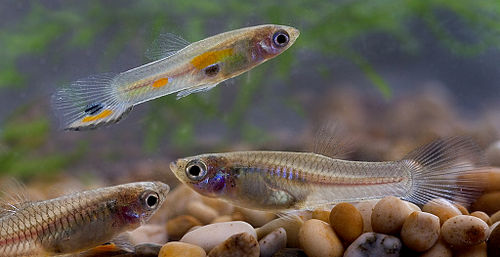
Golden Wonder Killifish
Aplocheilus lineatus

Min Tank Size
75L
Adult Size
10 cm
Lifespan
4 years
About
Native to South and Southeast Asia, from India down through Sri Lanka and parts of peninsular Malaysia, the Golden Wonder Killifish is actually a selectively bred color form of the striped panchax. The wild type has a more subtle greenish-gold pattern with red-tipped fins, but the cultivated golden variety cranks up the yellow and metallic shimmer to something genuinely eye-catching.
They're surface hunters through and through, with a flat-topped body profile and a distinctly upturned mouth that tells you exactly what they're built for. Size-wise, they routinely hit 8 to 10 centimeters in captivity, making them the largest of the commonly kept killifish by a considerable margin.
Despite being predators, they're surprisingly hardy and tolerant of a wide range of water conditions, including slightly brackish setups. A pH between 6.0 and 7.8, temperatures from 22 to 28 degrees Celsius, and soft to moderately hard water all suit them fine. They don't ask for much.
Feeding is easy since they go after pretty much anything meaty at the surface. Floating pellets, freeze-dried insects, live or frozen mosquito larvae, crickets, and even small earthworms are all fair game. They quickly learn to recognize feeding time and will hover expectantly near the surface.
The challenge isn't care, it's tankmate selection. Anything small enough to swallow is dinner. Guppies, small tetras, neon-sized fish, and all shrimp are at risk. Pair them with robust mid and bottom dwellers that are too large to be eaten and you have yourself a low-maintenance, visually striking centerpiece fish. Browse real community builds featuring this species to see what actually works.
Water Parameters
Temperature
°CpH
GH
dGHKH
dKHSwimming Level
Flow Preference
Keeping multiple Golden Wonder Killifish together
Golden Wonder Killifish is mildly territorial. Small groups can work in spacious tanks with broken sightlines, but expect occasional squabbles.
Compatibility
The golden rule here is simple: if a fish fits in the mouth, it's food. Guppies, endlers, small danios, neon tetras, and all dwarf shrimp are off the table entirely. Good companions are fish that occupy the mid and lower zones and are large enough not to be eaten. Giant danios, larger barbs like tiger or rosy barbs, gouramis of medium size, severums, and robust loaches like clown loaches all work well. Bottom-dwelling catfish like bristlenose plecos or larger corydoras colonies are also safe. Aim for tankmates that hit at least 5 to 6 centimeters as adults and you'll avoid most disasters.
Commonly kept with
Species this one is most often paired withCommonly tried but avoid
Often paired, but shouldn't beCare Notes
Beginners consistently underestimate two things: the lid and the mouth. Golden Wonders are capable jumpers and will find any gap in a lid, especially at night. Mesh or tight-fitting glass covers are non-negotiable. The predation issue catches people off guard because the fish looks elegant and peaceful in the store, often housed with small fish. At home, those same small fish become prey within days. Feed meaty foods consistently since a hungry Golden Wonder becomes a more aggressive one. Floating foods are strongly preferred over anything that sinks out of their strike zone.
Behavior & Aggression
Golden Wonders are predatory rather than aggressive in the conventional sense. They don't pick fights or chase tankmates around the tank for territory. What they do is eat smaller fish, and they're efficient at it. Two males housed together in a tank under about 120 liters will show surface-level dominance disputes, with the larger fish shadowing and occasionally nipping the smaller one. These confrontations rarely cause serious injury but can stress subordinate fish over time. The aggression is mostly about food competition and personal space at the surface, not general belligerence.
Things to Know
- Will eat any fish or shrimp small enough to fit in its mouth.
- Strong jumper, a tight-fitting lid is essential.
- Males will fight if kept together in smaller tanks.
- Can handle slightly brackish water, useful for specific setups.
Community Sightings
No builds featuring this species yet.
Be the first to feature Golden Wonder Killifish in your build →Discover Tanks
Explore more builds from the community.


Explore More Species
More species to discover.